

The eye-watering sums brands spend on the Super Bowl are no laughing matter – but that doesn’t stop the vast majority of advertisers from trying every year.
This is the Super Bowl, after all, the Big Game, where brands aim to win bigly by getting big stars to land big laughs.
But in recent years, we’ve seen the Super Bowl become more than just an endless red-carpet parade of celebrities delivering cringe-worthy one-liners in a desperate bid for your hard-won attention.
OK, admittedly, not much more, but there’s no denying that these days brands are far more comfortable flexing their emotional muscles, showing they can tug at heartstrings as well as funny bones.
So, with the Super Bowl LX set to take place at Levi’s Stadium in Santa Clara, California next month (February 8), the question is: what will this year’s ads make us feel? What will be the biggest trends?
Well, to help, we handed our AI-powered creative testing platform a shedload of chicken wings and asked it to analyse data from the last six Super Bowls. Just to be clear, it looked at the hero campaigns that were televised during the Big Game broadcast rather than the accompanying teasers and social content.
For context, our platform’s algorithm is trained on tens of millions of human responses to ads. It enables advertisers to understand, within minutes, both the emotional and business impact of a video or image – without the need for audience panels. In short, it lets brands measure campaign effectiveness at scale.
We wanted to see whether this decade’s Big Game data could reveal any clues about what might define this year’s emotional ad trends.
Here’s what we found:
Prediction 1: Creative effectiveness will rebound after last year’s low point
Super Bowl 2025 was a stark reminder that buying a ticket to the Biggest Show on Earth is not a guaranteed route to creative success.
Yes, there were standout moments personally. The singer Seal quite literally becoming a singing seal. Eugene Levy’s runaway eyebrows. Kieran Culkin as a talking beluga whale. But alongside these ‘highs’, 2025 delivered the least effective Super Bowl advertising performance since 2020.
Let me explain, using DAIVID’s proprietary Creative Effectiveness Score (CES) – a composite metric which combines the three main drivers of effectiveness: attention, emotions and memory – the average Super Bowl LIX ad scored 6.2 out of 10, which is the lowest average since 2020 (see chart below).
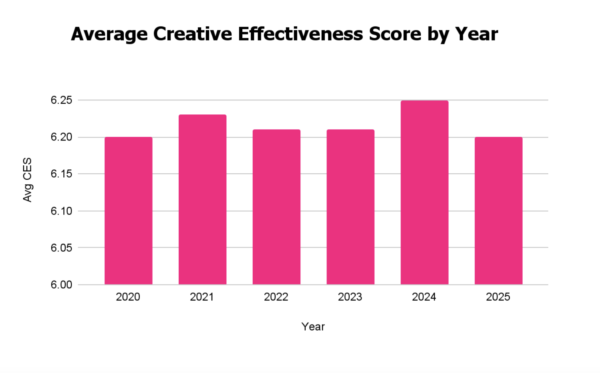
The Super Bowl remains advertising’s biggest stage, but in an era of fragmented attention, personalised media and rising scepticism, scale alone no longer guarantees impact.
Last year’s ads generated the joint lowest levels of positive emotion this decade, matching the low seen in 2022.
They also delivered the joint second-lowest attention in the crucial first three seconds. At the same time, negative emotional responses were the joint highest, while correct brand recall fell to its lowest level since 2021.
In short, splashing out $8 million on 30 seconds of airtime is a high-stakes bet – and one that doesn’t always pay off. So what happens next?
Despite last year’s results, brands are clearly undeterred. NBC announced back in September that it sold out Super Bowl ad slots in record time, signalling continued confidence in what the Big Game has to offer, despite the jaw-dropping costs.
And it’s easy to see why. The Super Bowl still attracts more than 110 million viewers each year, making it the most-watched event in the US. Crucially, around half of that audience is actively watching the ads. Even for viewers who couldn’t tell a touchdown from Tom Brady, the commercials remain part of the cultural moment.
For that reason, a rebound in creative effectiveness this year wouldn’t be surprising. With last year’s dip acting as a wake-up call, brands have a clear incentive to refocus on emotional impact, early attention and distinctive branding – the fundamentals that separate expensive airtime from effective advertising.
Prediction 2: Brands will continue to try to make us laugh, with mixed results
Let’s face it, we could all use a bit of light relief right now. Keeping up with the news these days should come with its own health warning – a constant stream of bad headlines, crises and things you didn’t even know you were supposed to worry about.
Enter the Super Bowl.
Humour is making a comeback at the Big Game. Over the past few years, amusement has been trending upwards (see chart below), with the last three Super Bowls proving to be the funniest of the decade. Ads in 2024 were the most likely to make viewers laugh this decade, and 2025’s spots were 11% more likely to elicit laughter than those in 2021.
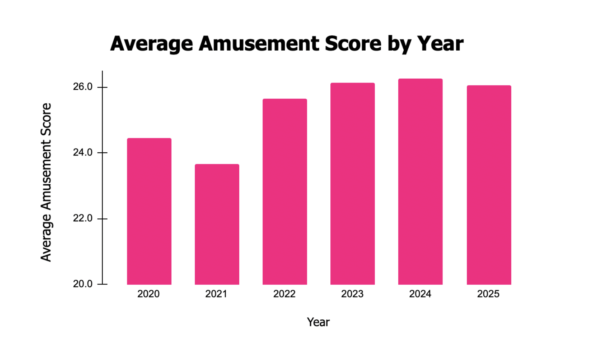
Of course, a lot of it still missed the mark. But brands certainly tried: of the 67 ads we tested in 2025, 49 used amusement as the primary emotion. With brands hoping to provide some welcome light relief, this is a trend we expect to continue this year, though once again results will likely be mixed. The hope is that brands have learned from last year’s lessons and won’t focus solely on making people laugh. As any stand-up comedian will tell you, making people laugh is the hardest thing in the world – so it’s always smart to have a backup emotion in case the jokes don’t land.
A few ads in 2025 got this just right. Mountain Dew’s “Kiss From a Lime” made our top 10 most effective ads, drawing the biggest laughs of the night: 37.3% of the audience found it intensely funny (+72% versus the US norm). But what set it apart was that it didn’t rely on humour alone. Alongside laughter, it triggered surprise and excitement. Shots of Mountain Dew Baja Blast even generated craving, double the US average.
Meanwhile, Budweiser’s “First Delivery”, which ranked 10th, is another strong example. Sure, it made viewers chuckle at the ‘horse walking into a bar’ joke, but it also elicited intense feelings of craving, nostalgia and trust that were all well above the US norm.
Hopefully, this year we’ll see more brands following this approach: using humour as an entry point, while layering in other emotions to drive real impact. After all, the Super Bowl is as much about making people feel something as it is about making them laugh.
Prediction 3: It will leave us squirming on our Super Bowl sofas
With brands leaning more into humour, particularly surreal or offbeat jokes, there has been a noticeable increase in feelings of awkwardness. In fact, ads at the 2025 Super Bowl were the most likely to make viewers feel awkward this decade.
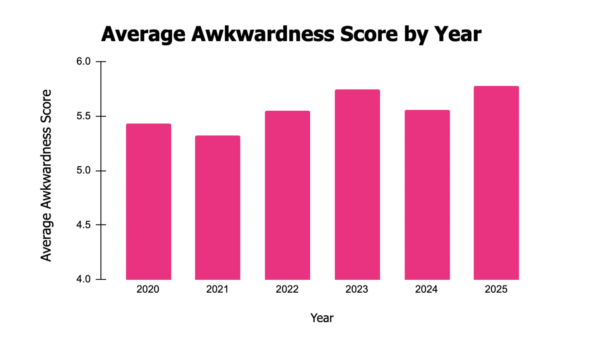
That’s not necessarily a bad thing – awkwardness can capture attention and make an ad memorable – but it’s a delicate balance. Too much, and viewers tune out or form negative associations with the brand. Take, for example, some of the more outlandish celebrity-led spots, such as Pringles’ flying moustaches. While they drew laughs from many, others were left cringing, highlighting how subjective humour can be.
No doubt this year we will once again see brands pushing the envelope, leaving many squirming on their sofas. In a crowded field and with sometimes only 30 seconds to make a heavy imprint on consumers’ minds, brands need to stand out as much as possible.
But once again the hope is that brands have a back-up plan of emotions to fall back on.
Prediction 4: They will make us drool
OK, saying Super Bowl ads will inspire a fridge raid isn’t exactly groundbreaking. But the data tells a tasty story.
With food and beverage brands increasingly dominating the Big Game, ads have become noticeably more appetising in recent years. Since the start of the decade, Super Bowl commercials have become 22% more likely to make viewers’ mouths water.
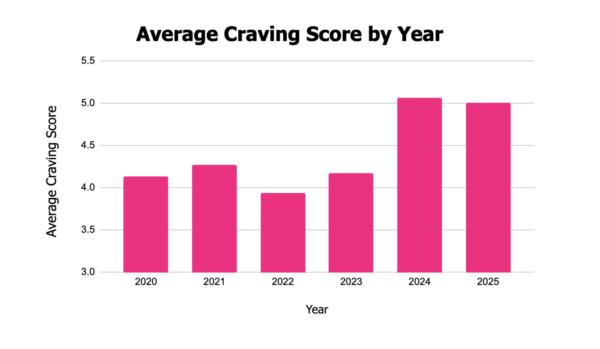 Whether it’s a perfectly stacked burger, a fizzy soft drink, or a tasty takeout meal, these spots make you want to eat your bodyweight in nachos – or at least sprint to the kitchen at half-time.
And with brands like Hellmann’s, Ritz, Kinder Bueno, Pringles, Lay’s and Pepsi already announcing they will be pushing out spots at Super Bowl LX, along with food delivery companies such as Uber Eats and GrubHub, this upward trend shows no signs of slowing down.
Prediction 5: They will make us reminisce
Again, it’s not exactly surprising that Super Bowl advertisers are expected to dip into our pasts once more this year. Nostalgic tingles are a well-worn creative device – a way for brands to extract maximum emotion from viewers in a very short space of time. But this year, we expect Super Bowl advertisers to lean even further into it.
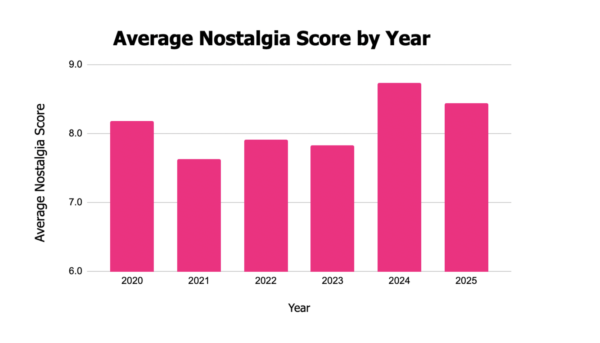
Just as I’ve started avoiding the news and turning to old movies and TV re-runs to escape the bin fire that is the world today, there has been a noticeable swing toward nostalgic content in recent Big Games. The last two Super Bowls have generated the strongest levels of nostalgia this decade, with 2025 ads evoking 11% more nostalgia than those in 2021.
So get ready to go back to the future once again.
Prediction 6: Feelings of trust will be the lowest this decade
One noticeable trend that is likely to concern Big Game advertisers is that feelings of trust at the last Super Bowl were the lowest this decade, reflecting a broader erosion over time (see chart below).
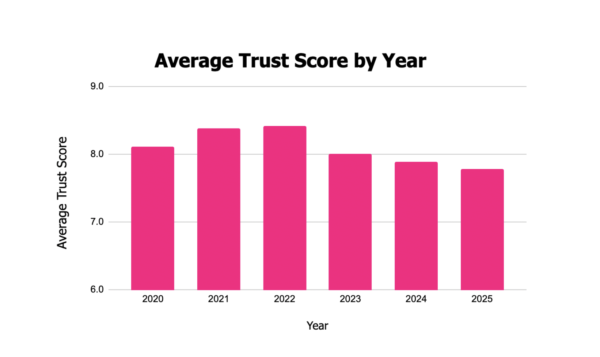 Several factors may have contributed to this decline.
Firstly, overall trust in advertising has been falling, partly due to a shift in audience preference toward personalised, relevant messaging rather than one-off, large-scale campaigns. People are simply tired of being bombarded with online ads that feel irrelevant to their lives.
Another factor is the creative approaches adopted by Super Bowl advertisers in recent years. In 2025, many ads leaned heavily on unusual concepts, celebrity appearances or surreal elements that didn’t clearly connect to the brand’s core value prop. While some viewers found these spots entertaining, others were just creeped out, undermining authenticity and trustworthiness.
Looking ahead to 2026, with more brands expected to experiment with AI-generated content, alongside AI companies and weight loss brands likely to buy Big Game slots, it would be no surprise if this trend continues.
Our own studies of AI-generated ads show that overall performance is broadly in line with industry benchmarks. However, one emotion consistently scores higher: distrust. When viewers aren’t quite sure what they’re seeing, scepticism creeps in, making authenticity more important than ever.