


For a brand built on cleanliness, Dettol has found itself in an unexpectedly sticky situation.
The British hygiene company has been forced to apologise after an ad it released in China, intended to challenge sexist attitudes, instead prompted widespread condemnation from viewers who felt it reinforced the very stereotypes it meant to challenge.
The four-minute film, which you can watch here, dubbed a “micro-drama”, follows a man searching for a partner he describes as “clean” and “not tainted by other men”. The story later turns, with his girlfriend confronting him over his views and ending the relationship. Dettol then steps in as the cure, with toxic men cast as the bacteria.
The issue, however, is that very few viewers made it far enough to reach the intended payoff. All they witnessed was the bad behavior.
Dettol has since removed the ad following the backlash, stating that its aim had been to challenge gender stereotypes but that online clips and excerpts had distorted its meaning.
It’s a timely reminder of the risks brands face when pumping out content within a restless internet where context is fragile and attention is fleeting, regardless of the original intent.
But could pre-testing the content have helped?
Well, to find out, we ran the ad through DAIVID’s AI-powered Creative Data API to see what kind of reactions the campaign would generate.
Trained on tens of millions of human responses to advertising, our predictive algorithm reveals the emotional and business impact of ads within minutes without the need for audience panels, enabling advertisers to measure campaign effectiveness at scale.
Here’s what we found:
Attention was low throughout
Maintaining attention levels across a four-minute runtime was always going to be a challenge. And it’s even harder if you don’t grab viewers in the first few seconds.
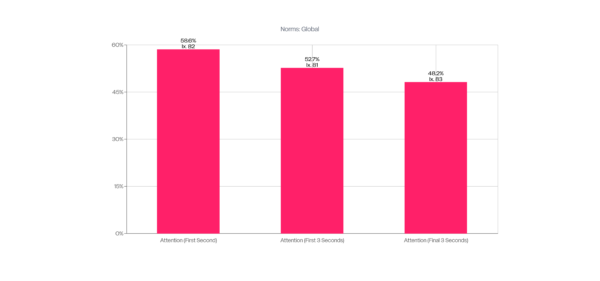
Attention wasn’t just low towards the end. Put off by the boyfriend’s comments, viewers began switching off from the opening few seconds.
As the chart below shows, Dettol’s ad attracted below-average attention levels throughout, including the critical first three seconds, the moment that typically determines whether a viewer keeps watching at all.
If people are switching off or scrolling past before the story even has a chance to turn, the twist becomes irrelevant. It’s not that the ending failed. It’s that most viewers never reached it.
Predicted attention levels
Boredom levels peaked at the most important part
Again, if you force viewers to sit through a long runtime, you really have to make it worth their while.
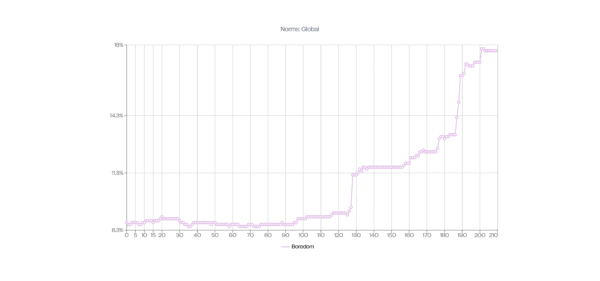
But, as you can see from the chart below, feelings of boredom spike at the most crucial point of the ad (the payoff). It means anyone who actually stuck around till the end were probably too busy yawning to take in the whole point of the ad.
Boredom levels over time
Negative emotions are off the chart
Whatever the ad was trying to make people feel by the end, the data suggests most viewers never got there.
Instead of feeling relief or even admiration at the intended message, most viewers instead came away feeling angry, discomforted and repelled. Not exactly a healthy brand recipe.
As you can see from the chart below, the ad is 348% more likely to provoke anger than the average ad, 191% more likely to trigger disgust and 157% more likely to leave viewers feeling awkward.
Viewers are also twice as likely to feel shame and sadness, with overall negative emotions running 58% above the norm. On the flip side, overall positive emotions are below average, with feelings of admiration (-24.7%), adoration (-35.5%) and inspiration (-17.6%) all below the norm.
Key negative emotions
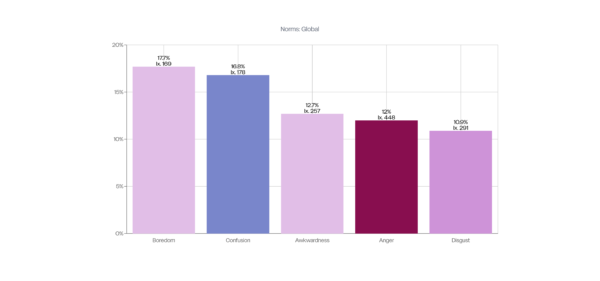
With viewers this emotionally disorientated, is it any wonder that confusion levels were 78.3% higher than average?
Overall effectiveness
After all of that, it’s probably no surprise to learn that the ad did not perform well for overall effectiveness.
Using our Creative Effectiveness Score (CES) – a composite metric combining emotions, memory and brand recall – Dettol’s ad scored 5.41 out of 10 for overall effectiveness. That puts it in the bottom 35th percentile and below the global norm of 5.8.
Overall effectiveness summary
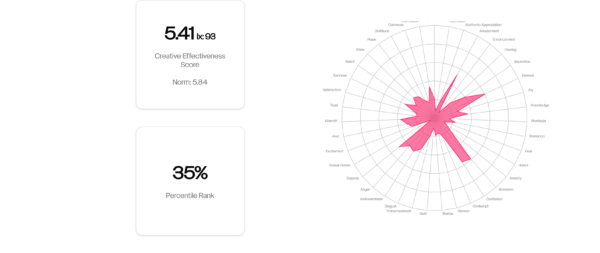
The only thing that stopped it scoring even lower still was that correct brand recall sat slightly above the norm, while the share of viewers who couldn’t recall any brand at all was 48% below benchmark. People knew it was Dettol. Whether that’s a good thing, given everything else, is another question.